

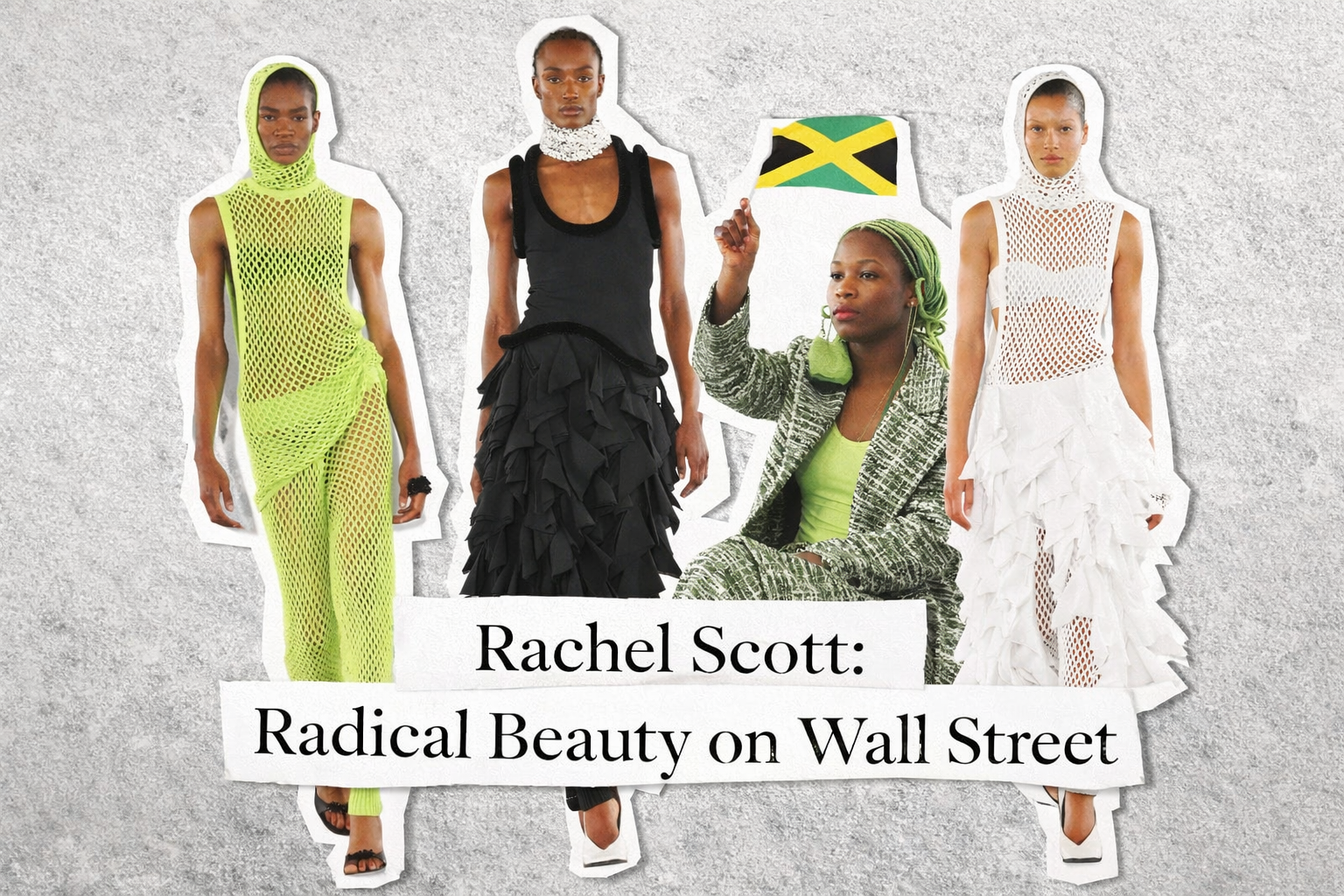
There are fashion shows that sell clothes.
And then there are fashion shows that release something into the atmosphere.
Rachel Scott’s Radical Wall Street Runway

For Fall 2026, Rachel Scott chose the latter.
Inside a stripped-back Gothic building in Manhattan’s Financial District, concrete floors exposed, stained glass fractured by winter light, Scott presented her latest collection for Diotima just days after stepping into her new role as Creative Director of Proenza Schouler.
The timing mattered.
The location mattered even more.
To stage a collection rooted in Caribbean consciousness and anti-imperial thought within walking distance of the Stock Exchange felt deliberate — almost confrontational. Diotima may be a growing business, but at its core it remains something more urgent: a creative practice built on resilience.
Femme Cheval: Beauty as a Trojan Horse

This season, Scott titled the collection Femme Cheval, drawing inspiration from Cuban modernist Wifredo Lam, whose work fused Surrealism, European modernism, and Afro-Caribbean symbolism. Lam once described his art as an “act of decolonization,” embedding resistance within beauty itself.
Rather than reproduce Lam’s imagery directly, Scott translated his language through construction and texture. Deep greens and muted pastels dominated the palette. Silhouettes felt surreal yet grounded. Tailored coats moved with asymmetric hems that fluttered mid-stride. Knit dresses carried intricate geometric tension.
A tapestry-style jacquard skirt paired with a wide-collared jacket evoked layered canvases. A gown composed of handwoven organza in tonal blues and greens felt atmospheric, dense, intentional, sculptural.
This was not a light collection.
It carried weight: emotional, political, architectural.
Craft, Collaboration, and Community
Scott’s signature codes remained intact: crochet, beading, looped yarn, bra tops paired with fringed skirts. But this season, craft expanded beyond aesthetic.
She collaborated with a 28-year-old Mexican artisan she met through the New York-based Refugee Atelier, an organization connecting displaced creatives with fair-wage textile work.
That partnership quietly underscored the thesis of the collection. Resistance is not only expressed in message, it is embedded in process.
A Jamaican Flag in the Financial District

As models walked, their heels struck concrete with a sharp rhythm. From the front row, sprint icon Shelly-Ann Fraser-Pryce waved Jamaican flags a subtle but powerful gesture of diasporic pride inside the epicenter of global capital.
Tears followed the finale.
The models cried.
Scott cried.
Her team cried.
There was no spectacle in it. Just release.
In a fashion system often dominated by commercial calculation, this moment felt stripped of performance. It wasn’t about proximity to power even though Scott now holds one of the most powerful roles in American fashion. It was about conviction.
Fashion With a Spine


Backstage, Scott spoke candidly about her disillusionment with the current political climate in America. Few designers navigating luxury retail dare to articulate such direct frustration.
But Scott is not building for the moment. She is building for longevity in the community.
And the business case supports her stance. According to The RealReal’s 2025 Luxury Resale Report, Diotima saw a 152% increase in searches last year.
Proof that clarity of vision does not alienate consumers. It magnetizes them.
Fashion does not have to default to escapism to succeed.
Sometimes, the most commercially viable thing a designer can do
is mean exactly what they make.
Disclaimer: I do not own the rights to these photos, no copyright infringement intended. For removal of photos, please email: hautepeople@yahoo.com


